Of Alsations, casseroles, villages and storks

Colmar is a pleasant city, ….

click on the photos to enlarge

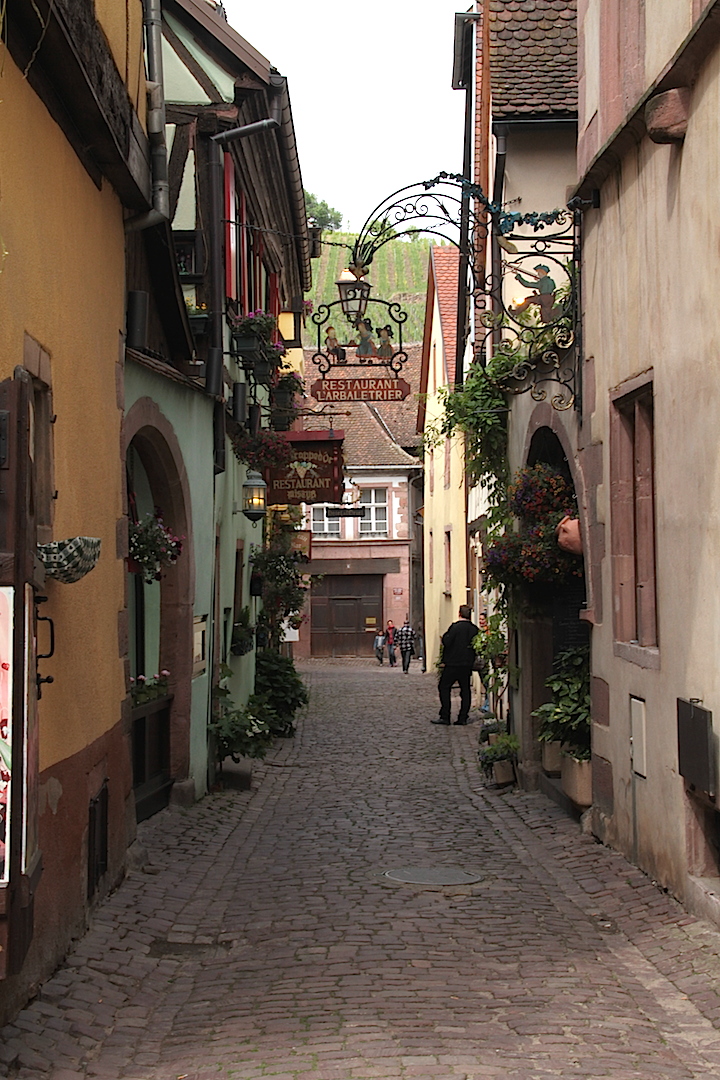
Little Venice is probably an ambitious name, but it is a particularly scenic area of Colmar

‘it is situated on a fertile plain, far from the mountains, an hour along the track, with large quantities of wine and grain on either side, and the land is good for wheat, onions and other fruit of the garden. This city is the centre of Alsace and is a single league away from Kiesersperg, Ammersweiler, Rechenwyer and Rappoltzweyer, towns that make most excellent wine, the finest of all Alsace’ in the words of one Sébastian Münster in 1552. Yes, 1552! Unfortunately Messieur Münster lived many years too early to be treated to the delicate tastes of Messer’s Pierre Jourdan, Danie de Wet and many more who produce those fine ‘tranquille’ Cabrières, Chardonnays or Sauvignon Blancs way way down south at the tip of Africa. Judging Messieur Münster’s praise for the Alsace wines, I am very sure he would have approved with great satisfaction the younger South African products.

However, he was justly accurate in his description that Colmar is a pleasant city, even beautiful with its stunning, be it slightly confusing architecture. This is France in 2014, but the German Tudor style is in abundance, and beautifully restored, maintained, decorated and neatly painted sitting there just waiting to be photographed or painted. I can’t paint, though. To understand this slightly confusing ‘look’ of this treasure of a French city, I had to ask Google for clarity.

Cafe in the beautiful Colmar

Colmar is first mentioned in 823. Roughly around 1226, Colmar was made an imperial town (city formally responsible only to the emperor in the Holy Roman Empire) by Frederick II of Hohenstaufen, a Roman Emperor. In 1278, King Rudolph of Habsburg gave Colmar its civil rights. Rudolph was originally a Swabian count, but was the man who sort of started the Habsburg dynasty, who ruled much of Europe for nearly 600 years from the 1200s out of current day Austria. Thus, this is the first mention or reason for the German architecture and place names so evident in French Alsace.

Ever since those days, there was a tug of war (pun intended) between the Germans and the French for this beautiful little town. In 1648 the Treaty of Munster handed part of Alsace back to France. In 1871 the Treaty of Frankfurt sees Alsace come under German rule again and a German ‘kommisar’ replaces Mayor Peyerimhoff. In 1883, French is banned from all official documents. On 23 August 1914 a French cavalry rides into town, but hesitantly retreats back into the mountains when the confrontation gets too hot! ‘Zeez French were lovers, not fighters!’ However, on 18 November 1918 the French troops moves into the city and the Tricolor once again is hoisted. It was still not the end, though. June 1940, those dark dark days in European history dawn on Europe and the German troops again annexed Colmar and Alsace. They take it so far that everybody between the ages 14 and 18 is forced to join the Hitler Youth! Then, five years later on 10 February 1945, General Charles de Gaulle marches into Colmar after the battle was one a week earlier.

May 29, 2014, my family and I ride into Colmar after a relaxing full-day road-trip of a mere 440km from Köln through some tiny little roads which included parts of the Mosel Valley, and unpack our weekend luggage. Colmar features as the second town in the recent article ‘The 23 Most Quaint Small Towns You Must Visit Before People Find Out About Them’ on sfglobe.com. So, maybe this post of mine will spoil Colmar for a few future visitors since I can now, after my visit actively promote Colmar as a worthy visit.

‘Quaint small town’, however, is a very loose term for many of these gem towns we so enthusiastically seek out. Europe is really old, as can be seen from the time-line above, which means for a destination such as Colmar, the ‘quaint small town’ is purely the centre old part of town. The village is surrounded by a large busy modern and often ugly outside city which does distract from the experience. In the ‘quaint small town’ of Colmar, we bought our groceries in one of the largest modern supermarkets E.LeClerq I have seen. The E.LeClerq chain is widely spread across France, and I always wonder whether it is the successful result of Messieur Le Clerq, the ‘often disguised as a secret onion seller’ in Allo Allo’s venture.

 https://www.youtube.com/watch?v=ZelPcA2Dz2c

That centre ‘quaint small town’-part is definitely worth a visit though. It provides ample awe-inspiring old-Europe architecture, the beautiful buildings, people watching, fine cuisine and photo opportunities galore. I often regard the highly spoken of ‘flammekueche’ also known as ‘Tarte de Flambee’ in these parts as a lame effort to copy a pizza and hardly ever order that. This weekend though I was pleasantly surprised by the excellent cheeses the Colmar chefs use to dress their ‘flammekueche’ and I thoroughly enjoyed the local ‘potjiekos’ dish (its more a casserole) called ‘baeckeoffe’

My Baekeoffe
My Baekeoffe

or ‘baker’s oven’ (see the German in this French province). It consists of sliced potatoes, onions (bought from Mssr LeClerq, no doubt), carrots, cubed meat, predominantly beef and pork, which have been marinated overnight in Alsatian white wine and juniper berries before being slow cooked in a traditional sealed ceramic casserole. The taste is further enhanced with leeks, parsley, garlic, marjoram, thyme and time.

As I tend to do, I did drive to the real quaint towns too with a day-drive through the likes of Neuf-Brisach, Breisach, Riquewihr, Hunawihr and Eguisheim. Under the title ‘the most quaint towns’ Colmar can never be visited in isolation. To complete the experience, one has to visit Riquewihr, the fortified church in Hunawihr and the quaint Eguisheim too. Neuf Brisach is a nice to see due to the fact that the town in its entirety is still walled and moated off, but the other three are pristine examples of the feudal medieval towns where the town was build and walled off around the church and market square. Nowadays there are plenty of little bistros, cafés, bars and restaurants lining the streets amongst the ‘vinstube’, cheese merchants and in general typical local merchandise aimed at the tourist market. To complete the picture, these little villages are nestled in the midst of the famous Alsatian vineyards, which prompted me to make a note to visit the area in autumn again.

The streets of Riquewihr
Still Riquewihr
Still Riquewihr

Riquewihr

An environmental feel-good story in this part of Alsace is for sure the breeding of the storks. I remember reading a book in primary school translated from Dutch into Afrikaans as ‘Die wiel op die skool’ (the wheel on the school), which was a story about the school providing nesting to a stork. Well, that is all I remember of the story, or maybe not even. I suppose the name gave me a hint. Nevertheless, I have now seen it with my own eyes. Many a roof in Alsace, even in the centre of towns, have a wheel of some sorts on its roof, with a breeding stork happily returning the stares of the tourists in the streets below while caring for their young.
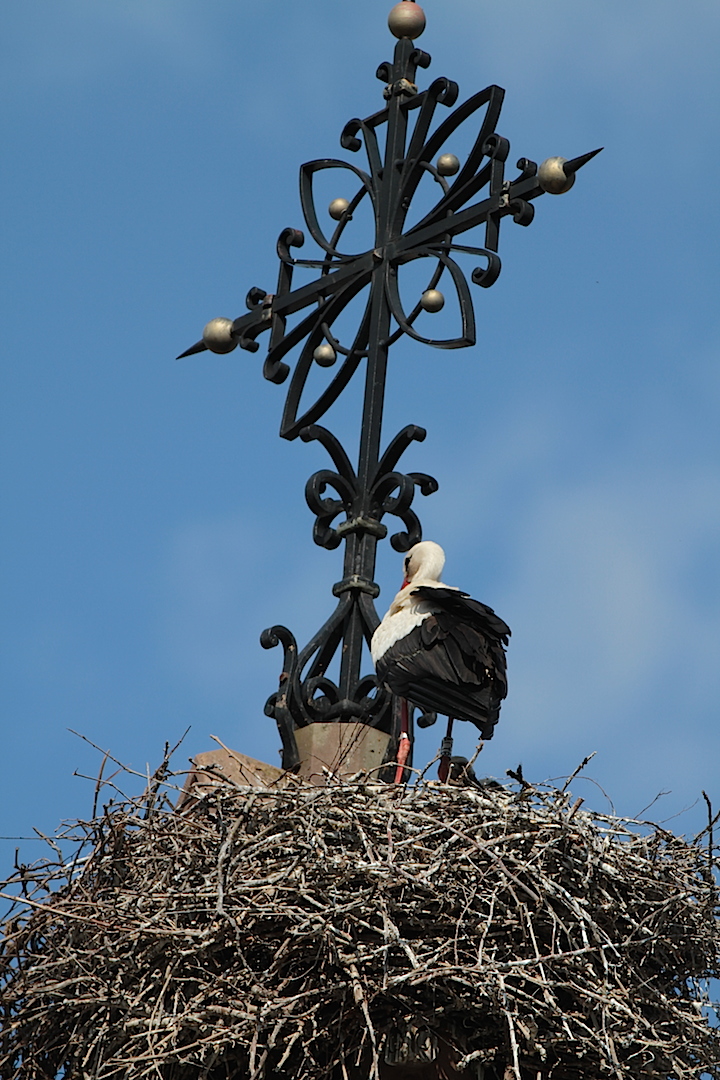
Stork happily nesting in Eguisheim
Hunawihr
Hunawihr
The fortified church in Hunawihr

As a dog owner, the term Alsatian obviously rings an inquisitive bell. I found the explanation rather interesting. The name German Shepherd, for the Deutsher Shäferhund, a breed which obviously originated in Germany, was changed by the UK Kennel Club after World War 1 due to the belief that ‘German’ in the name would harm the breed’s popularity due to the negative sentiment towards the Germans at that time. Thus, the UK Kennel Club officially changed the name to ‘Alsatian Wolf Dog’ after the name of the French German border area of Alsace. Many other international kennel clubs used this name. The name was officially changed back to German Shepherd in 1977, though ‘Alsatian’ is still often used in parenthesis.

 Colmar1

The camping scene in Europe is a curious but very healthy industry, which covers a wide range of different vehicles and tents. I was pleasantly surprised to find a real stove-like fireplace in our pitched tent, complete with wood and chimney through the canvass. Novel touch by the French! The most popular camping for the Europeans are definitely the motorhome (various shapes and sizes) and normal caravan. However, tiny tents, from one consisting of only a stretcher bed with a meter high tent on the stretcher to old-timer restored VW Kombis (as we know them in South Africa) and completely fitted Land Rover camper vans grace the lawns with their presence. I wonder if that Swiss Land Rover has ever put rubber to a dirt road. A number of people cycle, others travel by motorcycle and a few hitch-hike with their rucksacks if not using conventional transport. But the travel and sightseeing scene is truly alive and well in the rural areas of Europe.

The camping scene
The camping scene

So, yes, I agree with the article in http://sfglobe.com/?id=908&src=home_feed regarding Colmar. Incidentally I have also visited Annecy and can vouch for that too. And where they state in the article ‘We advise you to plan a trip before they become too crowded!’ I sincerely hope my blogpost regarding Colmar doesn’t make your planned trip too late. However, feel free to contact me for advice when you need advice or help or a chauffeur!

I am so looking forward to our summer tour to Italy in a few weeks.
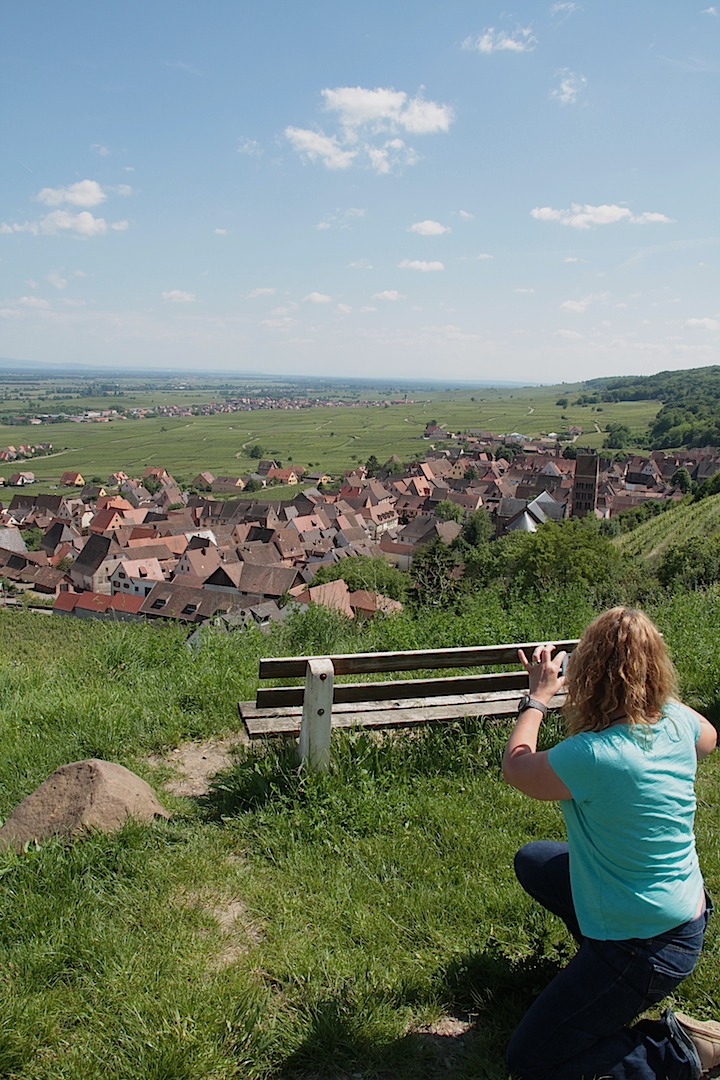
Eguisheim

‘London calling’

‘London calling to the faraway towns

Now war is declared and battle come down…’.

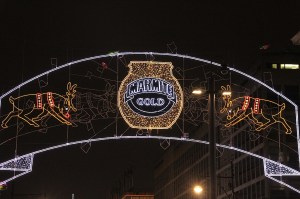
The call by punk rockers The Clash in 1979 was now very relevant. A war was declared, with the Springboks and the Roses (doesn’t sound too intimidating a war to me) agreeing to fight it out on the battlegrounds of the former cabbage patch, Twickenham, plus I was based in a faraway town across The Channel. I was in ideal circumstances to slip over the Channel for a quick London sightseeing invasion. Furthermore, my Marmite stocks were completely depleted and I had to heed to the call to refill this life essential provider of happiness. ‘It’s marvellous what Marmite can do for you’.  I was thrilled to see that even the London Christmas lighting honoured this delicacy which was always so part of my life.

Marmite
Even in the Oxford Street Christmas lighting the legacy of marmite is alive

It felt a little bit like ‘home’ driving the rental car out of Gatwick as here too, as in South Africa, they drive on the right side of the road; the left side. I must admit, or boast, that the switching of driving sides is no problem anymore and even driving the manual Astra felt very familiar and comfortable. As a matter of fact, the whole familiar feel of England ito language, food, sport and everything else all contributed to make this very short weekend a delight. I grew up in Durban and thus the ‘English’ feel was rather nostalgic. Never nostalgic enough to support the English in sport, though!

In my 8th blog post ‘Rome’ I mentioned our friends from England who committed us to that delightful weekend in Rome. It was them at it again who organised the test tickets for Twickenham and though Jenny could not make it, it was a real pleasure to have a few beers with Dave, meet Rob and enjoy some test rugby on probably the headquarters of world rugby even though the rugby itself was a dull affair.

Twickenham2

I suppose the mere fact that the Bokke ended their end of year tour unbeaten makes it aTwickenham success in the books, but I’m still seriously worried at the way they do their business. Fortunately, the English were so far behind in terms of self believe, creativity and structure that the Bokke could scrape through. I just wish these guys will realise kicking is for karate, while running is for rugby. I suppose I should have posted this criticism before this past weekend, when the ‘poor’ Roses beat the ‘mighty’ All Blacks as I suppose the Roses made me eat my words of earlier in this paragraph. Luckily for me I’ve already written them.

I believe whatever statics quoted on the number of Saffas in London is wrong by 53.27%; there are many more. On the Underground after the game it was coincidentally funny when Oom Jan from Hartswater, Northern Cape chatted up two young guys from, wait for it, Hartswater, Northern Cape and who have been staying in London for the better part of 8 years. Oom Jan was on a weeklong rugby-supporting trip all the way from this little town so many miles (oops sorry, kilometres) away and here in London on the same coach he bumps into two guys from his hometown, and who knows him. They did find it hard to swallow though when Oom Jan showed them his son, a little further down the coach, as it seems this poor guy had much more hair and less kilograms when they last saw him! Tip to all South Africans out there, always watch what you say, there’s always someone nearby who can understand you, maybe even knows you.

Taussauds
I am sure I can see the worry in Madiba’s eyes at what will go down in Mangaung in two weeks’ time, and wishing he was 30 years younger to get them back on the right track

On all my previous visits to London I’ve always declined visits to Madame Taussauds, as it seemed to be such a lame artificial place. But it turned out to be one of those experiences where, once you drop your bias, it becomes an exciting outing to pose for photos with the likes of Morgan Freeman, Lionel Messi, Nelson Mandela or Spiderman, even though they have all had feet of wax. The highlight was a delightful 4D show of the Avengers super heroes, even though the lady who sat behind me probably didn’t sleep for the next week, so tensed up and scared was she by the realistic in-your-face effects. I was already out of the theatre but I could still hear her sighs and moans of relief that it was over, and amazement at what she just saw, heard and even felt.

I like things to be understood in perspective. So ‘small’ and thus accessible is Europe that London by car from my Köln house is a mere 580km (512km if the Easyjet flies) while Durban from my Irene house in SA is 607km. It’s just as easy to visit London now than it was to visit Durban, and just think of all the cheeses, waffles, chocolates and types of sausages amongst many more things to see, taste and photograph while traveling through Germany, The Netherlands and Belgium to get to England. It’s just that tunnel under the sea that’s kept me from driving there!

Kersmark
Not all are equally interested in the Christmas markets, especially if Tom Clancy has your attention

“I’m leaving on a jet plane, don’t know when I’ll be back again”

“So, where do I begin

To tell the story of how great ……..”

Jip, it’s a love story, born out of a love to travel.

Probably OK to start when things started falling in place but to really provide insight, I’m going further back to provide proper background. I think its rather important that you understand why and what gave reason for us to embark on change; real huge change. And then what a move like this really entails.

Since Heleen and my first ever overseas trip we’ve always wanted and hinted on going overseas. There was always some sort of adventurous pulling factor for us to also “experience it!” We settled into jobs early in our life and jobs became careers, we became a family of four and we “settled for suburbia” and comfort.

Then we made a mistake! We introduced our kids to travel. They liked it and we liked to be able to share experiences, cultures and diversity with them. In the back of our minds we started thinking of giving them exposure and opportunity wider than Pretoria and South Africa. In the old days expanding horizons meant you move from, say Hofmeyer, to the cities, such as say Bloemfontein. In the current “global village” Bloemfontein can easily become Europe and this we decided is what we want to experience.

Important here for me to mentioned that we want to experience living abroad, experiencing different cultures, ways of coping and be able to travel for cheaper, because destinations are closer. I love South Africa and we are not “leaving” South Africa. We are gaining Europe at the moment. Understand this. I will miss Karoo dirt roads, Kruger, Kgalagadi, West Coast, The Sharks, the Bushveld, Midlands, the Overberg and all other wonderful places and things in SA, but for now I will gain what Europe can give.

OK, so back to now. Exxaro presented me with an elegant opportunity to exit, and though with emotions I didn’t know I had, I left my 21 year comfort zone, security and excellent employer to pursue something new. What that something will turn out to be I still need to find out. Heleen, on the other hand also received an excellent opportunity. She could pursue new opportunities within her current employer, T-Systems; continue her good career and gain international working experience while we pursue our dream of the Europe experience thing.

Heleen and I have been so blessed through our lives and all necessary moving parts fell into place to realise this dream and opportunity. I thank God for looking after us.

So, packing up a huge house in which four “gatherers” have been living for 16 years was one massive task. Practical issues such as my wine, which I could not relocated to Germany for practical and import duties reasons had to find new homes. Its stupid to “store” wine when you leave for an uncertain period as most of it is good drinking wines. I handed out wine in excess of 100 bottles! And now, here in Germany drinking cheap local reds, how I whish I had a few of those reds and chardonnays I know so well!

Books, furniture and personal stuff which will never fit into a standard German residence had to be dumped as storage to friends and family and I must say, they all came to our help on this challenge, thanx guys again for your help and support.

But other challenges of what we embarked on were Martha and Kgomotso, our live-in domestic help of 22 years and her son, attending the local Irene Primary School. Furthermore, finding good homes for three dogs that have been much part of our lives for the past 8 years proved an emotional drain as soon as the packing started. I now understood that clichéd phrase “the devil is in the details” fully when our concept of moving abroad had to be realised through impact on each and every little detail of our lives.

However, we are now in Germany. We’re living in temporary accommodation to provide time for our stuff to arrive and time to house-hunt. Both of these already seem to be more complicated than originally thought, but more on that a little later. Part of our stuff to arrive is the 10 boxes of airfreight not included in the crate of everything which will be sent via sea-freight. This airfreight includes my coffee machine, and those of you who know me, will know how important that is!

The kids are in St George’s, The English International School (50° 52.516’N 6° 56.802’E) in a little town Rondorf in southern Koln while we currently live in Bonn (50° 43.293’N 7° 9.405’E). I’m commuting them everyday and already that seems a time consuming effort. They both settled in nicely and we already had a fruitful parent teacher evening where feedback on both Cara and Stean was extremely positive. This school exposure already proves very interesting after the strict disciplined and nearly draconic experiences of previous schools on issues such as hair, uniform, make-up and general attire. Cara loves attending school with hair hanging loose, wearing boots to school (its cold out here) and replacing them with “pumps” for the school day! I know a few guys back home who’ll flip over if they see this.

Bonn was the capital of West Germany from 1949 until unification in 1990 and the official seat of government of united Germany from 1990 to 1999. It is located on the Rhine River and is an extremely scenic city, with forests, greenery and farmland around it. Typical in Germany and Europe is that there are plenty of little “Irene-like” villages around the main centers. Rondorf is one such town.

So, after just more than two weeks all seems fine, but the grind will come. Language, culture, ways of doing and just plane differences from the Suffas way will surely kick in soon!